All ranking lists are inherently ludicrous, and taking them too seriously is a fool’s errand, but I was genuinely shocked at some of the omissions in fairly high profile lists this year. I’ll leave it to you to work out which ones I’m talking about. And on the other side of the argument, everyone losing their minds over FKA Twigs this year had me initially baffled and then increasingly irritated. She worked with Anyma, the blandest man in all of electronic music!
My list is heavily biased towards droning ambient textures, unnecessarily bleak electronica and overly sentimental, er, sentiments, occasionally punctuated by some of the shiniest, most mainstream pop currently available, but it’s the best list by far.
These are the 50 best album of 2025.
50. Great Grandpa – Patience, Moonbeam
49. Lily Allen – West End Girl
48. Nation of Language – Dance Called Memory
47. Rainy Miller – Joseph, What Have You Done?
46. Penelope Trappes – A Requiem
45. Kaitlyn Aurelia Smith – GUSH
44. Dylan Henner – Star Dream FM
43. Klein – sleep with a cane
42. Marta Fosberg – Archaeology of Intimacy
41. Gwenno – Utopia
40. Night Tapes – portals//polarities
39. Curtis Harding – Departures & Arrivals
38. Lea Sen – LEVELS
37. Florian T M Zeisig – A New Life
36. Florist – Jellywish
35. Binary Algorithims – Reminiscencias
34. Jadu Heart – POST HEAVEN
33. Marina Zispin – Now You See Me, Now You Don’t
32. Dania – Listless
31. Sandwell District – End Beginnings
30. Kathryn Mohr – Waiting Room
29. Opsin – through the wall
28. Kelly Moran – Don’t Trust Mirrors
27. Demdike Stare – To Cut & Shoot
26. Arvin Dola – O Ghost
25. jp – we’re here all the time
24. Barker – Stochastic Drift
23. Valentino Mora – Biotope
22. 36 – A Warm Static Sphere
21. Addison Rae – Addison
20. james k – Friend
19. Joanne Robertson – Blurrr
18. Dijon – Baby
17. Yagya – Vor
16. Blood Orange – Essex Honey
15. anaiis – Devotion & The Black Divine
14. Camille Schmidt – Nude #9
13. Joshua Burnside – Teeth Of Time
12. Erika De Casier – Lifetime
11. John Glacier – Like A Ribbon
———-
10. Voices From The Lake – Voices From The Lake II
09. Kpop Demon Hunters – Kpop Demon Hunters
08. Saya Grey – SAYA
07. OHYUNG – You Are Always On My Mind
06. XENIA REAPER – Gambling
05. Tren – Tears Of Things, Sorrows of the Universe
04. Lucy Gooch – Desert Window
03. Voice Actor – Lust 1
02. Natalie Bergman – My Home Is Not In This World
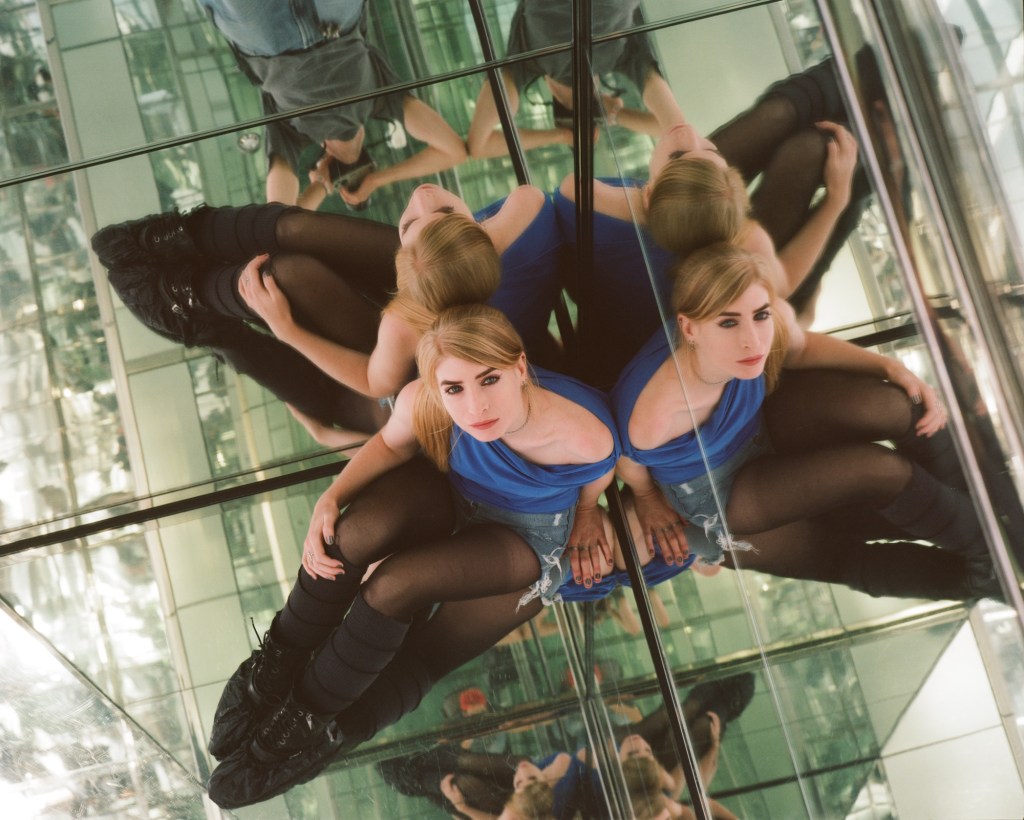
Kelly Moran is a composer, producer and performer working at the borders of minimalist electronics and extended piano technique. Classically trained, she came up studying 20th-century composition and prepared piano, later folding synthesis, generative sequencing and computer processing into her writing. Her connection to machines deepened through time spent with the Yamaha Disklavier and Disklavier-connected environments, where the instrument’s automated precision shaped her sense of space, decay and restraint
Her latest LP Don’t Trust Mirrors arrived in October 2025 on Warp Records, a meditation on distortion as both sound design and self-portrait. A club-leaning companion to 2024’s Moves in the Field, the album’s palette grew from prepared piano, live electronics, and Moran’s custom Disklavier arrangements, but its inspiration was interpersonal reflection rather than technical display.
In our interview she talks about those parallel selves: the touring hedonic performer and the quieter, post-lockdown writer at home. We also discussed a pivotal moment at Approximation Festival in Düsseldorf in which Moran challenged the festival’s attempt to draw a line between politics and art, her account of which speaks to the wider pressures artists now carry: hyper-visibility expectations on platforms like Instagram, algorithmic penalties for political speech, and a media landscape reshaped by layoffs, inflation, and AI saturation.
You wrote some of the earliest Don’t Trust Mirrors pieces while partying through festivals, then finished the project in a much quieter, post-lockdown reality. When you play this material now, which version of yourself do you feel closest to: the hedonistic touring mode, or the person stuck at home trying to reimagine everything?
Honestly, these are the two wolves that live inside me at all times. But I think I feel way closer to the touring hedonist when I’m performing the material because being on stage always gives you a huge confidence boost that is super energizing and it reminds me why I made this music to begin with.
You have talked about how sensitive you are to a room’s energy, right down to when you lift the pedal or stretch a phrase. Has there been a recent show where the way people were listening actually changed the shape or pacing of a Don’t Trust Mirrors piece in the moment?
Not for these pieces in particular – whenever I perform material from Don’t Trust Mirrors, I’m maneuvering between electronics and a keyboard (or a piano) and everything is mostly locked in place. These pacing changes tend to come when I’m performing solo piano music because there’s no coordination with outside musical elements, and I can be as loose as I like. At my album release show a few weeks ago in NYC, I was feeling the room’s energy very intently as I was playing some pieces by Ryuichi Sakamoto to close out my set. I could tell how quiet and focused the audience was, and it made me move through the sections of the pieces super deliberately and slowly. I took really long breaks between sections to let the notes decay because I could sense how attentive the audience was hanging onto every note, and it was really beautiful to be able to savor the music with them in this way.
You have said the Disklavier taught you a lot about restraint, and you were learning Sakamoto’s music at the same time as watching horrific news unfold in Gaza. How much of that climate, political and emotional, do you hear back in Don’t Trust Mirrors when you listen now?
I don’t hear it in my own music as much as I feel it in Sakamoto’s – simply because the genocide in Gaza began during the month I was learning all of Sakamoto’s music. His music is deeply delicate and requires a lot of restraint and sensitivity, so it was a massive contrast to go from watching these horrific, violent scenes unfold and then going to the studio to immerse myself in this super gentle music. It helped me process a lot of what I was seeing and made me want to be a more kind and gentle person in the face of these horrors.
This brings us to Approximation Festival in Düsseldorf. You were invited by Hauschka, and you’d admired him for a long time.
Yes. I discovered his music when I was in college and exploring prepared piano. When I saw him perform in New York in 2017, I actually waited after the show and gave him one of my CDs. So years later, being invited to play his festival felt meaningful. This was during the period when I had already been speaking about Palestine at all of my shows. A few days before, I emailed the festival team to say I speak about Palestine during my set, and Volker replied saying that the stage was reserved for art only and that the festival was not a place for politics.
I responded saying that I don’t believe that art and politics are separable. That we are always creating work inside a shared reality. And that, for me, as an American whose tax dollars are directly funding what’s happening, speaking is a moral necessity. We went back and forth. Eventually we agreed that instead of a full political statement, I would simply dedicate the remaining pieces in my set to the children of Gaza.
I played my set, and then when it came time to speak, I thanked the festival, I said I admired Volker’s music, I explained how I had been recording Sakamoto’s pieces at the same time the assault on Gaza intensified, and how that music represented a way to stay soft and open in the face of horror. I dedicated the rest of the performance to the children of Gaza. And then, very quietly, because my whole body was shaking, I said, Free Palestine. I did not shout it. My voice was barely above a whisper. And the audience erupted. People came up to me after the show and came to the merch table to thank me. The feeling in the room was one of recognition.
But the next day a local newspaper published an article saying that I shouted anti-semitic statements. It claimed that the audience fell silent. It claimed that the atmosphere was uncomfortable. It claimed Volker condemned me and said I had broken an agreement. They used the phrase anti-semitic repeatedly. What struck me was how deliberate the framing was. It was not confusion. It was not misunderstanding. It was narrative management. It was a rewriting of the event to align with an institutional position.
You have spoken about feeling awkward on Instagram Live and being asked to “show people peeks into your life.” What has your own experience of this cycle been, where the industry expects hyper-visibility while your practice is built on long, private hours with an instrument?
I used to be very flippant and casual about posting on social media, then I got signed to Warp and I got way more self conscious about how I was perceived. I almost felt like I didn’t know what people wanted from me – am I supposed to be mysterious and inaccessible, or should I be down to earth and share everything? I tend to be a pretty open person in real life and wear my heart on my sleeve, but I struggled maintaining that once I had a spotlight on me post-Warp. And I think COVID also made everyone more self-conscious about how to relate to other people, and I’m still figuring out the best way to do that on my platforms. I remember making a separate instagram for my cat after I got signed because I thought, well, it’s time to be more serious about making my accounts focus on my music! But people actually LOVE seeing my cat and glimpses into my day-to-day life, so I’ve been trying not to overthink so much and just post what I feel like. I just did a “day in the life” video for bandcamp’s instagram, and I was low-key horrified at how embarrassing my video turned out – as though I think my life is interesting enough to do this kind of influencer content! – but I got an insane amount of DMs of people saying they loved seeing what a day in my life was like and how charming it was. I think the best advice is just not to overthink everything! Very few people are going to remember what you posted on instagram last week, or even yesterday!
How have label conversations, booking pressures, or expectations about “what a Kelly Moran record should sound like” shaped the choices you did or did not make on Don’t Trust Mirrors?
Warp has never made me feel like I need to have a certain sound and have been very encouraging to me about following my creative instincts. But I will say that making a record after you’re signed to a label is a much different experience than making a record and then getting signed. When I made Ultraviolet, I didn’t really have any concrete hopes or expectations because I was just following a really potent creative idea and not thinking about how it would be received since I didn’t know where the project was headed – I didn’t have a label or a team. Warp heard the record and wanted to put it out, so that was a nice surprise after all that hard work! But now, I am acutely aware of the fact that the music I make will be released on Warp Records, and that is a lot more pressure than I’ve ever felt. It’s not necessarily coming from them, it’s more coming from myself because I have a great opportunity and want to make the most of it. But it is a lot harder knowing that what I’m working on will be part of this collection with really high standards and a very critical fanbase. I have trouble turning off that awareness when I’m making music now!
From where you sit, what feels like the hardest part of being a working musician right now? Not in the abstract, but in the very real day-to-day sense of trying to make art, pay rent, and stay sane inside an industry that often feels unstable at every level?
You just summed it up – it’s actually hard to stay sane in an industry that feels unstable at every level! For me, the hardest thing is not losing hope and giving up – simply because there are so many challenges on every level. The industry has completely changed in the last 7 years. There are fewer press opportunities since so many publications have shuttered and laid off staff. Inflation has made touring more difficult since costs have gone up. It feels like you have to constantly adapt to these changes and it’s really hard. Sometimes the music industry feels like a sick game where the goalposts are always moving. Like, we’ve been bitching about how unfair streaming is for years, but now it’s worse because we have to compete with AI artists. There is just so much slop on the internet that you have to compete with to be seen, and that is fucking hard!
Recently a lot of artists and I have been talking to each other about how the instagram algorithms are fucking us over and how difficult it is to get our audiences to actually see the work we post. That is insanely frustrating because we rely on these platforms to spread the word about our work, and the algorithms are always changing. There’s all these weird rules you are supposed to follow for better engagement and if you don’t follow them, instagram will penalize you. And if you post about politics you will get shadow banned. So, stuff like that is really frustrating because it feels harder and harder to reach your audience and potential fans! There’s kind of this expectation that you have to post lots of different content – reels, carousels, stories, ETC! – and that is a lot of fucking work to do, it’s like a whole separate job in addition to making art.
Anyway – I can go on and on about other things that make it hard, but I’ve been thinking about the above lately because I have to use social media to promote my work.
When the work is this intricate and emotionally loaded, what actually helps you switch off? Do you have a way of coming down from the intensity of writing, rehearsing, or touring that doesn’t pull you back into thinking about the music?
One of my greatest creature comforts is watching reality tv with my cat Wendy. It is strangely comforting and grounding to me to watch reality slop. I usually watch an episode of Survivor or Real Housewives before going to sleep. It’s a level of escapism that has nothing to do with art or music, it’s the ultimate way to switch off my brain and not think about any creative work!
Having pushed this material through two albums, a tour, and a whole visual world, where is your curiosity pulling you next? Are you already working on something that deliberately steps away from the piano, or is the next phase about going even deeper into this instrument and its electronics?
I’ve actually been thinking a lot about how I can better integrate electronics/synth with the sound of un-prepared piano. Don’t Trust Mirrors centered around prepared piano with electronics, and Moves in the Field didn’t have any electronics combined with the piano aside from sub-bass, so part of me has been curious about how my music will sound if I merge my synth tendencies with a cleaner piano sound. I also want to collaborate with other artists on my next album – I’ve been weirdly controlling about not having many collaborators on my solo albums, but I think I should be more open minded and see how my music transforms when I let other people in because the collaboration I did with Bibio on Don’t Trust Mirrors has turned out to be one of my favorite pieces ever. Stay tuned!
The Spanish composer and sound artist on the fragile solemnity of a late-period Low masterpiece.
The premise of One Track Mind is pretty simple: I ask artists to pick one track that means a lot to them – either something they’ve discovered recently, something that’s been with them for years, or one that reminds them of a specific time in their life or career – and tell me what makes it so special to them. I get to talk to the artists I love, and they get to talk about the artists they love. Love all round!
Spanish composer and sound artist Arvin Dola works at the intersection of music, cinema, and performance. His background in scoring for film and theatre informs a deeply textural approach, where sound becomes a vehicle for memory, emotion, and unresolved narratives.
His new LP O GHOST is his debut album release and is inspired by absence, memory, and the weight of unresolved time. Written in the wake of personal loss, it folds grief into a subtle kind of presence. Drawing on hauntology and shaped by Dola’s work in film and performance, the record blends ambient, drone, and disintegrating motifs that never quite land or leave.
For his One Track Mind selection, Arvin has chosen to highlight a track from an incredible album which also happens to be one of my all-time favourites.
The Nashville-based dream-folk artist on transportive power of a Bob Dylan live performance
The premise of One Track Mind is pretty simple: I ask artists to pick one track that means a lot to them – either something they’ve discovered recently, something that’s been with them for years, or one that reminds them of a specific time in their life or career – and tell me what makes it so special to them. I get to talk to the artists I love, and they get to talk about the artists they love. Love all round!
Marissa Nadler has been quietly reshaping the edges of folk for more than two decades. Her records linger in that space between dream and memory, carried by a voice that feels both fragile and unshakable. Across nine albums, she’s built a body of work that blends spectral storytelling with a painter’s eye for detail, often shifting between stark acoustic pieces and more expansive, layered arrangements.
Her new album, New Radiations, continues that trajectory with a subtle but noticeable shift. The songs carry her usual haunted grace, but there’s a warmth that feels new: textures of synth and soft percussion woven around her fingerpicked guitar. The record holds to her talent for atmosphere while suggesting a degree of light breaking through the familiar shadows.
For her One Track Mind selection, Marissa has chosen to highlight a live version of a song from a folk legend.
It’s that time of year again when we pretend that ranking music matters much more than is really does, and that our own taste is the best. And mine really is! Read on for proof of this.
Included in this list are ambient abstraction that sounds like 90s trance, indie rock albums in the midst of an existential crisis, and electronic records that feel like they might just collapse under their own weight, or are so spectral they’re barely even there. And despite everyone telling me how wrong I am, no Charli XCX at all. For other gaping holes or obvious omissions, I make no apologies whatsoever.
Here are the 50 best albums of 2024. They might change your life.
Given how many people are likely to read this, the amount of time I spent deciding which albums made the cut this year is frankly ridiculous. I’ve listened to hundreds of albums this year, and barely feel like I’ve scratched the surface. And despite my best efforts, there’s still no metal.
My preference for meandering ambient, breathy female vocalists and nostalgia-inducing electronica still continues to dominate. If you’re into any of this, lucky you!
I’m genuinely relived to be putting my own selections out there so I can now start the far more enjoyable process of going through all the other end of year lists and finding everything I missed.
Here it is! The absolutely in no way definitive list of the very best albums of 2022, as decided by me and me alone. This is not a democracy. This list is biased, subjective and missing entire genres (tough luck metal!), however it is – of course – also the best list you’re likely to read.
Year after year I continue to be blown away by the amount of insanely good music released by people I had previously never heard of, and 2022 is no exception. I hope you’ll find something to enjoy.
The time has come for me to spend a frankly absurd amount of time agonising about not only which albums are worthy of TWP’s acclaim, but exactly where in the table of acclaim said albums should lie. It’s been a hand-wringingly tense experience, but we are finally here. Thank fuck for that.
Of course, the enormous elephant in the room is Traumprinz, or DJ Irini to be more specific. A couple of months back the anonymous producer posted a 3 hour set comprising brand new material on the Planet Uterus Soundcloud. Not quite a mix, definitely not a full album, it doesn’t really qualify for this list. And literally as I was writing this up today they posted another four separate sets of music that so far is amongst the most extraordinary stuff I’ve heard in this or any other year. Sufficed to say, if there had been anything approaching a proper ‘album’ from all these various drops, it would have almost certainly topped this list.
Regardless, once again it’s been yet another incredible year for music, and more specifically the album: a year of highs and lows; of huge artists underdelivering; of previously unknown artists completely blowing me away. Music continues to give me more joy than pretty much anything in my life, and I am continually grateful for its constant presence.
Here, then, are TPW’s picks for the very best albums of 2021.







 The Predatory Wasp