
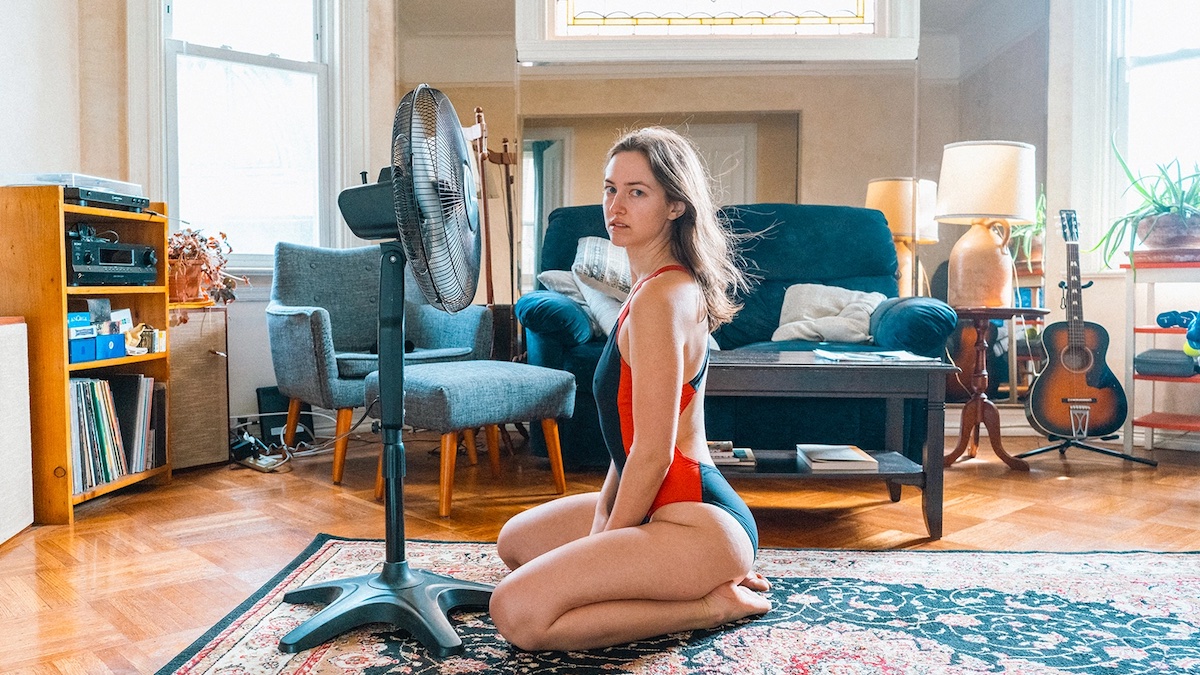
“It is a constant and newfound and likely lifelong journey to stay in touch with myself”
Brooklyn-based singer-songwriter Camille Schmidt has quickly carved out a space for herself in the indie-folk world with her raw, introspective songwriting. Her debut EP, Good Person, released in June last year, introduced her deeply personal storytelling, exploring themes of shame and perfectionism with an acoustic, intimate sound.
Since then, Schmidt has expanded her sonic palette, embracing elements of punk and synth-pop on her excellent debut full-length album, Nude #9, which arrived last month.
In her interview for TPW, Camille reflects on the shift in her musical style, the personal experiences that shaped Nude #9, the challenges of navigating vulnerability in songwriting, the pitfalls about writing about people you know, and the awkward conversations that follow.
The themes on Nude #9 span everything from queer identity to mental health and familial relationships. How did you navigate balancing such deeply personal topics without feeling overwhelmed or overly exposed in the process?
Oh yeah yeah great question. I felt more exposed when I originally wrote the songs, when the people close to me were hearing some of my thoughts and experiences for the first time. That felt scary. But the experiences themselves, most of them I had processed pretty fully before writing about them. And I will say that the songs are, yes, very personal, but there was a lot that I intentionally did not include: verses I took out, songs I didn’t put on the album because they were too personal to have out in the world.
When you’re writing your own music, do you change the way you listen to other people’s music?
Yeah definitely. When I’m in writing mode, I start to really break down songs, thinking about what works so well lyrically – is the narrative moving like an arrow from general to specific? How are things described? What does that key change do there? What mode is this song in? It’s sometimes a little harder to enjoy music when I’m in writing mode, because a different part of my brain is working. But the music that does hit when I’m in writing mode, that can bypass my critical thinking brain, really hits.
You reference your childhood memories of your parents’ art studio as inspiration for the title Nude #9. How has your early exposure to art shaped the way you approach creating music?
I feel lucky that growing up there was a general environment of creativity all around. It was sort of the norm, for anyone in the house to go off and do their own thing – to start drawing on a napkin, or get up to go work on an idea in their studio. So I think in a lot of unconscious ways it’s made writing music, or making art in general feel like a feasible part of life.
Nude #9 is less acoustic and ventures into genres like punk and synth-pop further compared to your previous work. How do you think this shift in sound affects how you expressed vulnerability and intimacy in your songwriting?
I think the shift in sound came as a response to the vulnerability. Like because I was able to dive deeper into a wider range of emotions, this required a wider range of soundscapes.
You’ve talked about wanting your songs to hold space for emotions that are hard to face alone. What’s a song or piece of art that has done this for you, and how has it influenced your own approach to creating music?
Maggie Nelson’s The Argonauts has been really big for me. She’s so honest about her experiences sexually, as a mother, as a thinker – that it has expanded the ideas in the cultural-consciousness of what it means to be a woman. And it’s her vulnerability that opens up this space.
You’ve described yelling in Daddy Long Legs as “freeing and cathartic”. Is there anything else —besides music – that gives you that same untethered, primal kind of release?
Jumping into cold water, swimming.
Proton Electron Photon seems to almost belong to a totally different album. Thoughts about making a purely electronic / experimental project? That’s something I would be very interested in!
God that would be so fun. I loved creating the world of Proton Electron Photon, and if more songs come out that want that sort of world then: yes.
Have you had any awkward “Hey, is this song about me?” conversations since the album came out?
Yup…
The writing process for this album involved stream-of-consciousness lyrics and diving into deeply personal territory. Were there moments where you felt resistance to being so honest, and how did you push through that?
Absolutely. Nude #9, the song, was the song it was hardest to be honest in – which is funny because that’s also a little meta, i.e. the song is saying “i wrote this song and it’s a lie, the truth always takes me some time.” It took me 6 months to figure out how to be as honest as I could be in that song. I’m still learning to sense which things come right away, which things you need to push through to get, and which things you need to leave for time to unravel. I’d tried to push through on that one, but it required time.
You’ve described Nude #9 as an attempt to stop hiding from yourself. After completing and releasing it, do you feel closer to understanding who you are—or has it opened up even more questions?
I feel more aware of the core that is in me. The part that is as still as a stone. But it is a constant and newfound and likely lifelong journey to stay in touch with that part, to return to it. Forgetting and remembering, leaving and returning.
You’ve spoken about how making Nude #9 taught you to trust yourself as an artist. Looking ahead, how do you see this newfound self-trust influencing the direction of your next project or performances?
I can feel this sort of self-trust transforming my performances – I move more, have more fun on stage. I’m at work on the next album and I can sense this new one is going to have an even wider range of emotion and sound. I’m still discovering exactly what that will look and sound like. And I’m honestly quite excited to find out.
Nude#9 is out now on all platforms.
 The Predatory Wasp